


For notaries
Attest to digital evidence that already arrives verified
The party brings the capture already hashed and timestamped from the moment of acquisition — verify it from the public portal before adding it to the deed, without depending on your own capture procedure.
The problem
Why attesting to digital content isn't that simple
Attesting to digital content requires being able to verify it, not just view it
A screenshot or video brought in by a party doesn't stand on its own — you need something independently checkable, not just their word for it.
A digital content deed shouldn't depend on the notary's own procedure
If the notary has to capture the screen themselves during the appointment, every deed depends on that procedure — without a hash and timestamp already applied before it ever reaches the office.
Digital content changes or disappears before the appointment
A post, a conversation, a web page — can be edited or deleted between when the client sees it and when they get an appointment.
How it's used
From the appointment to verification
Evidence already stamped, ready for the deed
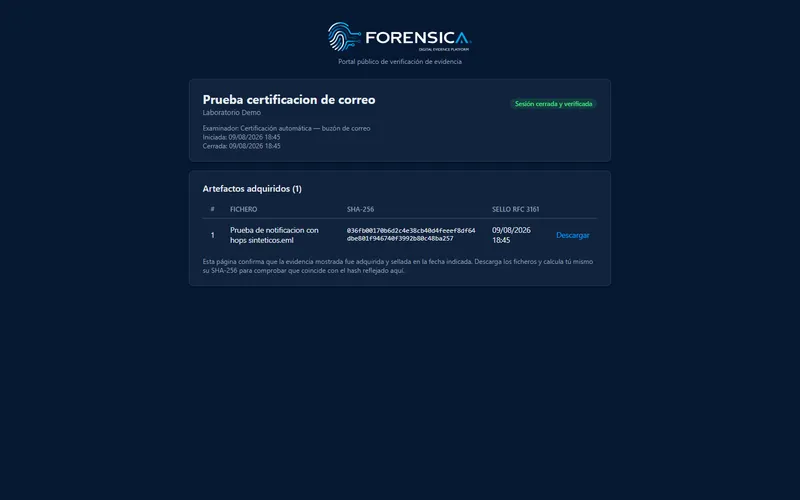
The party arrives with the capture already hashed and RFC 3161 timestamped from the moment of acquisition — no need to capture it again.
Public verification, nothing to install
Check the hash, timestamp and provenance from the public verification portal, with a link or a QR code — no account or software needed.
Double timestamp, client and server
A second, independent timestamp, obtained by the server on receipt, reinforces the date against a challenged client clock.
A record of who checked the evidence
There's a record of the access used to verify it, with date and IP — additional traceability for the deed.

Let's start
Let's talk about verifying evidence for a deed
We'll show you the public verification portal and how to check a hash and timestamp in a couple of minutes.